
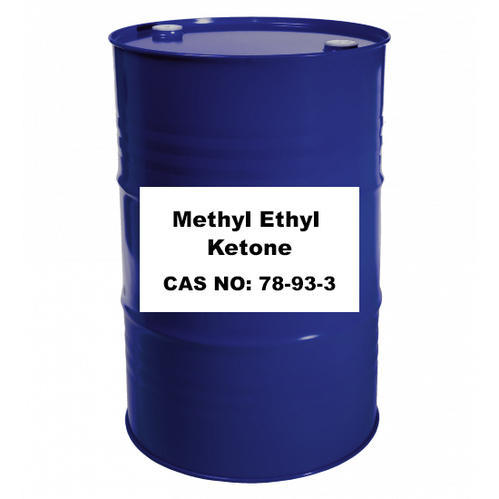
Butanone (MEK) ethyl methyl ketone Cas 78-93-3
Butanone (MEK) ethyl methyl ketone Cas 78-93-3
Butanone, also known as methyl ethyl ketone (MEK) or ethyl methyl ketone,[a] is an organic compound with the formula CH3C(O)CH2CH3. This colorless liquid ketone has a sharp, sweet odor reminiscent of acetone. It is produced industrially on a large scale, but occurs in nature only in trace amounts.[7] It is partially soluble in water, and is commonly used as an industrial solvent.[8] It is an isomer of another solvent, tetrahydrofuran.
Production
Butanone may be produced by oxidation of 2-butanol. The dehydrogenation of 2-butanol is catalysed by copper, zinc, or bronze:
- CH3CH(OH)CH2CH3 → CH3C(O)CH2CH3 + H2
This is used to produce approximately 700 million kilograms yearly. Other syntheses that have been examined but not implemented include Wacker oxidation of 2-butene and oxidation of isobutylbenzene, which is analogous to the industrial production of acetone.[7] The cumene process can be modified to produce phenol and a mixture of acetone and butanone instead of only phenol and acetone in the original.[9]
Both liquid-phase oxidation of heavy naphtha and the Fischer–Tropsch reaction produce mixed oxygenate streams, from which 2-butanone is extracted by fractionation.[10]
Applications
Solvent
Butanone is an effective and common solvent[8] and is used in processes involving gums, resins, cellulose acetate and nitrocellulose coatings and in vinyl films.[11] For this reason it finds use in the manufacture of plastics, textiles, in the production of paraffin wax, and in household products such as lacquer, varnishes, paint remover, a denaturing agent for denatured alcohol, glues, and as a cleaning agent. It is a prime component of plumbers’ priming fluid, used to clean PVC materials. It has similar solvent properties to acetone but boils at a higher temperature and has a significantly slower evaporation rate.[12] Unlike acetone, it forms an azeotrope with water,[13][14] making it useful for azeotropic distillation of moisture in certain applications. Butanone is also used in dry erase markers as the solvent of the erasable dye. Butanone (MEK) ethyl methyl ketone Cas 78-93-3
The hydroxylamine derivative of butanone is methylethyl ketone oxime (MEKO), which also find use in paints and varnishes as an anti-skinning agent.
Plastic welding
As butanone dissolves polystyrene and many other plastics, it is sold as “model cement” for use in connecting parts of scale model kits. Though often considered an adhesive, it is functioning as a welding agent in this context.
Other uses
Butanone is the precursor to methyl ethyl ketone peroxide, which is a catalyst for some polymerization reactions such as crosslinking of unsaturated polyester resins. Dimethylglyoxime can be prepared from butanone first by reaction with ethyl nitrite to give diacetyl monoxime followed by conversion to the dioxime:[15]

In the peroxide process on producing hydrazine, the starting chemical ammonia is bonded to butanone, oxidized by hydrogen peroxide, bonded to another ammonia molecule.
MEK in ethanol products
MEK’s role as an alcohol denaturant is crucial in industries where ethanol needs to be used in non-food-related products. One of its most common uses is in cleaning products, where denatured alcohol serves as an effective solvent for grease, oils, and other contaminants. Another application of denatured alcohol with MEK is as a solvent in the paint and coating industry. It aids in dissolving various resins and helps with paint formulation and application.
Methyl Ethyl Ketone
- Other Names:2-Butanone, Ethyl methyl ketone, Ethylmethylketone, Methyl ethyl ketone (MEK)
- Molecular Formula:C4H8O or CH3COCH2CH3
- CAS:78-93-3
- UN:1193
- Appearance: colorless liquid with acetone-like odor.
- Density:0.8 g/cm³
- Boiling Point: 79.64 °C
- Melting Point: −86 °C
- Flash Point: -9 ºC
Application:
It is used as a solvent for resins, coatings, inks, a binder for dyes, a lubricating oil dewaxing agent, a vulcanization accelerator, etc. Butanone is also an intermediate in preparing pharmaceuticals, dyes, detergents, fragrances, antioxidants, and specific catalysts.
Butanone (MEK) ethyl methyl ketone Cas 78-93-3, Butanone (MEK) ethyl methyl ketone Cas 78-93-3, Butanone (MEK) ethyl methyl ketone Cas 78-93-3, Butanone (MEK) ethyl methyl ketone Cas 78-93-3, Butanone (MEK) ethyl methyl ketone Cas 78-93-3, Butanone (MEK) ethyl methyl ketone Cas 78-93-3, Butanone (MEK) ethyl methyl ketone Cas 78-93-3, Butanone (MEK) ethyl methyl ketone Cas 78-93-3, Butanone (MEK) ethyl methyl ketone Cas 78-93-3, Butanone (MEK) ethyl methyl ketone Cas 78-93-3, Butanone (MEK) ethyl methyl ketone Cas 78-93-3, Butanone (MEK) ethyl methyl ketone Cas 78-93-3, Butanone (MEK) ethyl methyl ketone Cas 78-93-3, Butanone (MEK) ethyl methyl ketone Cas 78-93-3 Butanone (MEK) ethyl methyl ketone Cas 78-93-3, Butanone (MEK) ethyl methyl ketone Cas 78-93-3 Butanone (MEK) ethyl methyl ketone Cas 78-93-3, Butanone (MEK) ethyl methyl ketone Cas 78-93-3 Butanone (MEK) ethyl methyl ketone Cas 78-93-3
As butanone dissolves polystyrene and many other plastics, it is sold as “model cement” for use in connecting parts of scale model kits.
Though often considered an adhesive, it is actually functioning as a welding agent in this context.
Other uses
Butanone is the precursor to methyl ethyl ketone peroxide, which is a catalyst for some polymerization reactions such as crosslinking of
unsaturated polyester resins.
Dimethylglyoxime can be prepared from butanone first by reaction with ethyl nitrite to give diacetyl monoxime followed by conversion to the
dioxime
Butan-2-one; 2-Butanone; Ethyl methyl ketone; Ethylmethylketone; Methyl ethyl ketone; MEK; Methylpropanone; Methylacetone. CAS Number:
78-93-3
Flammability
Butanone can react with most oxidizing materials, and can produce fires.
It is moderately explosive, requiring only a small flame or spark to cause a vigorous reaction.
Butanone fires should be extinguished with carbon dioxide, dry agents, or alcohol-resistant foam.
Concentrations in the air high enough to be flammable are intolerable to humans due to the irritating nature of the vapor.
Health effects
Butanone is a constituent of tobacco smoke.[16] It is an irritant, causing irritation to the eyes and nose of humans.
Serious health effects in animals have been seen only at very high levels.
These included skeletal birth defects and low birth weight in mice, when they inhaled it at the highest dose tested (3000 ppm for 7 hours/day).
There are no long-term studies with animals breathing or drinking it, and no studies for carcinogenicity in animals breathing or drinking it:
There is some evidence that butanone can potentiate the toxicity of other solvents, in contrast to the calculation of mixed solvent exposures by
simple addition of exposures.
As of 2010, some reviewers advised caution in using butanone because of reports of neuropsychological effects.
Methyl Ethyl Ketone 78-93-3
EC / List no.: 201-159-0
CAS no.: 78-93-3
Mol. formula: C4H8O
2-Butanone
3-Butanone
Acetone, methylAethylmethylketon
Butanone
Butanone
butanone
Butanone 2
butanone; ethyl methyl ketone
Ethyl methyl cetone
Ethyl methyl ketone
ethyl methyl ketone
ETHYL METHYL KETONE (METHYL ETHYL KETONE)
Ethylmethylketon
Ketone, ethyl methyl
Meetco
MEK
Methyl acetone
Methyl ethyl ketone
Metiletilcetona
Metiletilchetone
Metyl ethyl ketone
Metyloetyloketon
Translated names
butanon (cs)
butanon (da)
Butanon (de)
butanon (hr)
butanon (hu)
butanon (nl)
butanon (no)
butanon (pl)
butanon (sl)
butanon (sv)
butanona (es)
butanona (pt)
butanonas (lt)
butanone (it)
butanone; éthylméthylcétone (fr)
Butanoni (fi)
butanons (lv)
butanonă (mt)
Identity (IR): conforms
Free acid (as CH₃COOH): ≤ 0.002 %
Density (d 20 °C/ 4 °C): 0.804 – 0.805
Water: ≤ 0.1 %
-
- A novel similarity search approach for high-performance thin-layer chromatography (HPTLC) fingerprinting of medicinal plants.: This research introduces a new similarity search technique for HPTLC, effectively enhancing the analysis of medicinal plant extracts and potentially increasing throughput in pharmaceutical applications (Hamedi et al., 2019).
-
- Determination of thermodynamic properties of poly (cyclohexyl methacrylate) by inverse gas chromatography.: The study offers a comprehensive thermodynamic analysis of polymer interactions using ethyl methyl ketone as a solvent, providing essential data for materials science and engineering (Pala et al., 2014).
-
- Synthesis, growth, structural, spectral, thermal, chemical etching, linear and nonlinear optical and mechanical studies of an organic single crystal 4-chloro 4-nitrostilbene (CONS): a potential NLO material.: This article discusses the synthesis and application of a nonlinear optical material using ethyl methyl ketone, contributing to advancements in optical device technology (Kalainathan et al., 2013).
-
- Synthesis, growth, structural, optical, spectral, thermal and mechanical studies of 4-methoxy 4-nitrostilbene (MONS): a new organic nonlinear optical single crystal.: Explores the development of a novel organic crystal with potential in nonlinear optical applications, leveraging ethyl methyl ketone in the synthetic process (Kalainathan et al., 2012).
-
- Two-dimensional thin layer chromatographic separation of phenolic compounds from Eupatorium cannabinum extracts and their antioxidant activity.: This study utilizes two-dimensional TLC, with ethyl methyl ketone as a part of the mobile phase, to analyze the phenolic content and antioxidant activity of plant extracts, highlighting its potential in bioanalytical applications (Robak et al., 2012).
- Methyl ethyl ketone (MEK; Other synonyms: 2-butanone; methyl acetone; ethyl methyl ketone; butanone) is a volatile, water-soluble, colorless
liquid with a characteristic odor resembling that of acetone.
Its odor threshold has been reported to be in the range of approximately 0.25 to 0.025 ppm (Krasavage et al. 1982, OHMTADS 1985).
It is soluble in about four parts water (27.5%) but is less soluble at higher temperatures; it is miscible with acetone, alcohol, ether, and benzene.
A constant boiling mixture with water, bp 73.4°C, contains 88.7% MEK.
The melting and boiling points of MEK are -86.35 °C and 79.6°C, respectively; its vapor pressure at 20°C is 70.6 mm Hg.
The specific gravity of MEK at 20°C/4°C is 0.805 and its vapor density is 2.41 (Air = 1).
MEK is flammable and its flash point is 16°F or -9°C (Merck Index 1983, Toxicology Data Bank 1985).
Methyl Ethyl Ketone also known as MEK, butanone, 2-butanone, butan-2-one, oxobutane, or methyl acetone is a clear volatile liquid that is
soluble in water and has a mild, acetone odour and has the molecular formula C4H8O, CAS: 78-93-3. It has a flash point of -9°C and a specific
gravity of 0.81.
Methyl Ethyl Ketone
Methyl Ethyl Ketone Chemical Structure Composition.
Production
The main commercial production route for methyl ethyl ketone is through the dehydrogenation of secondary butanol although newer
technology involves the direct oxidation of n-butene in solution, using palladium and cupric chlorides as catalysts.
The Chinese market is the main driver for the demand of MEK.
Uses
The majority demand is from the paints and coatings industry as a low viscosity solution can be obtained without it affecting the film properties
of the product. These lacquers are used in the automotive, electrical goods, and furniture industries.
MEK is also used in the manufacture of plastics and textiles, the manufacture of printing inks, and also in rubber-based industrial cements. It is
also used in the chemical industry as it is a precursor to methyl ethyl ketone peroxide which is itself used as a catalyst to initiate the
polymerisation of polyester resins used in fibre-glass reinforced products.
ATAMAN CHEMICALS is one of the largest chemical distributor in Europe.
ATAMAN CHEMICALS is handling the storage, transport, export & import formalities of Methyl Ethyl Ketone globally.
MEK is an active & organic solvent.
It is in a clear, inflammable and liquid form.
It is in the ketone groups.
It has a high evaporation rate.
It is one of the most widely used ketones in the industry.
Areas of usage:
It is used in organic synthesis reactions.
It is used in the sectors of paint, coating and detergent.
Butanone, also known as methyl ethyl ketone (MEK),[a] is an organic compound with the formula CH3C(O)CH2CH3.
This colourless liquid ketone has a sharp, sweet odor reminiscent of acetone.
It is produced industrially on a large scale, but occurs in nature only in trace amounts.
It is partially soluble in water, and is commonly used as an industrial solvent.
It is an isomer of another solvent, tetrahydrofuran.
Methyl ethyl ketone appears as colorless fairly volatile liquid with a pleasant pungent odor.
Flash point 20°F. Vapors heavier than air. Does not react with water or many common materials.
Stable in normal transportation. Irritates the nose, eyes, and throat. Combustion may produce toxic materials.
Density 6.7 lb / gal. Used as a solvent, for making other chemicals, and for production of wax from petroleum.
2-Butanone is a manufactured chemical but it is also present in the environment from natural sources.
It is a colorless liquid with a sharp, sweet odor. It is also known as methyl ethyl ketone (MEK).
2-Butanone is produced in large quantities.
Nearly half of its use is in paints and other coatings because it will quickly evaporate into the air and it dissolves many substances.
It is also used in glues and as a cleaning agent. 2-Butanone occurs as a natural product.
It is made by some trees and found in some fruits and vegetables in small amounts.
It is also released to the air from car and truck exhausts.
Applications
As a solvent
Butanone is an effective and common solvent and is used in processes involving gums, resins, cellulose acetate and nitrocellulose coatings and
in vinyl films.
For this reason it finds use in the manufacture of plastics, textiles, in the production of paraffin wax, and in household products such as lacquer,
varnishes, paint remover, a denaturing agent for denatured alcohol, glues, and as a cleaning agent.
It has similar solvent properties to acetone but boils at a higher temperature and has a significantly slower evaporation rate.
Unlike acetone, it forms an azeotrope with water,making it useful for azeotropic distillation of moisture in certain applications.
Butanone is also used in dry erase markers as the solvent of the erasable dye
Safety Information
pictograms
signalword
Danger
hcodes
Hazard Classifications
Eye Irrit. 2 – Flam. Liq. 2 – STOT SE 3
target_organs
Central nervous system
supp_hazards
Storage Class
3 – Flammable liquids
wgk
WGK 1
flash_point_f
30.2 °F – closed cup
flash_point_c
-1 °C – closed cup
Documentation
Certificates of Analysis (COA)
Search for Certificates of Analysis (COA) by entering the products Lot/Batch Number. Lot and Batch Numbers can be found on a product’s label following the words ‘Lot’ or ‘Batch’.
Reviews
There are no reviews yet.